
Weighing Ankara
The big question at the NATO summit: What's an alliance for?

The wide streets of Ankara are empty and silent this week. Not most of them, I’m sure, but certainly the ones carrying official vehicles to and from the various activities of the NATO heads-of-government summit. Broad boulevards, freshly paved, are closed to most traffic. Just about everyone on the streets I saw were uniformed police. Most seemed bored.
Distractions are unwelcome this week in Turkey’s capital. So, this being Recep Tayyip Erdoğan’s town, they aren’t permitted.
Donald Trump has said he only came to this summit because Erdoğan, who’s been a kindred spirit, is the host. He marked his visit by dropping sanctions he put in place against Turkey in 2020 for buying Russian surface-to-air missiles. He said he might sell Turkey F-35 fighters. But this isn’t just a Trump thing. Mark Carney had a meeting with the Turkish president too on Tuesday. There’s a general sense here that, despite the Erdoğan regime’s continuing contempt for pluralism and free speech, Turkey pulls considerably more than its weight in NATO. And NATO could use the help.
At the summit’s Defence Industry Forum, the alliance’s secretary general, Mark Rutte, said this year’s meeting is about “delivering results.” NATO member countries and big defense suppliers are signing contracts “worth billions, literally billions of dollars,” Rutte said. Finland is joining a multinational consortium to buy Airbus refuelling planes. Seven other countries are going in together on heavy-lift transport planes, also from Airbus. Swedish Saab GlobalEye aircraft will replace aging Boeing airborne surveillance planes across Europe after Canada selected the same plane in May. Still another group is buying up to five high-altitude, long-range drones — this time from Northrup Grumman.
Refuelling, heavy lift, airborne theatre surveillance: this is unglamorous but indispensable work, and for most of NATO’s history the Americans delivered almost all of it. Rutte kept calling these new capabilities “made in NATO.” They kind of have to be: the US is reducing its presence in Europe. Last week the alliance’s top commander, US Air Force Gen. Alexus Grynkewich, said NATO has replaced most of the capability the U.S. withdrew earlier this year. But more burden-shifting, to use a voguish and genteel term, could be on the way. The Americans are conducting a longer-term review of their force levels in Europe. The Trump administration’s standard tone for talking about the old continent is exasperation.
Trump arrived in Ankara stewing about allies’ reluctance to join his attack on Iran. “Why are we spending hundreds of billions of dollars, and they’re not there for us?” he said. “We’ve always been there for them.”
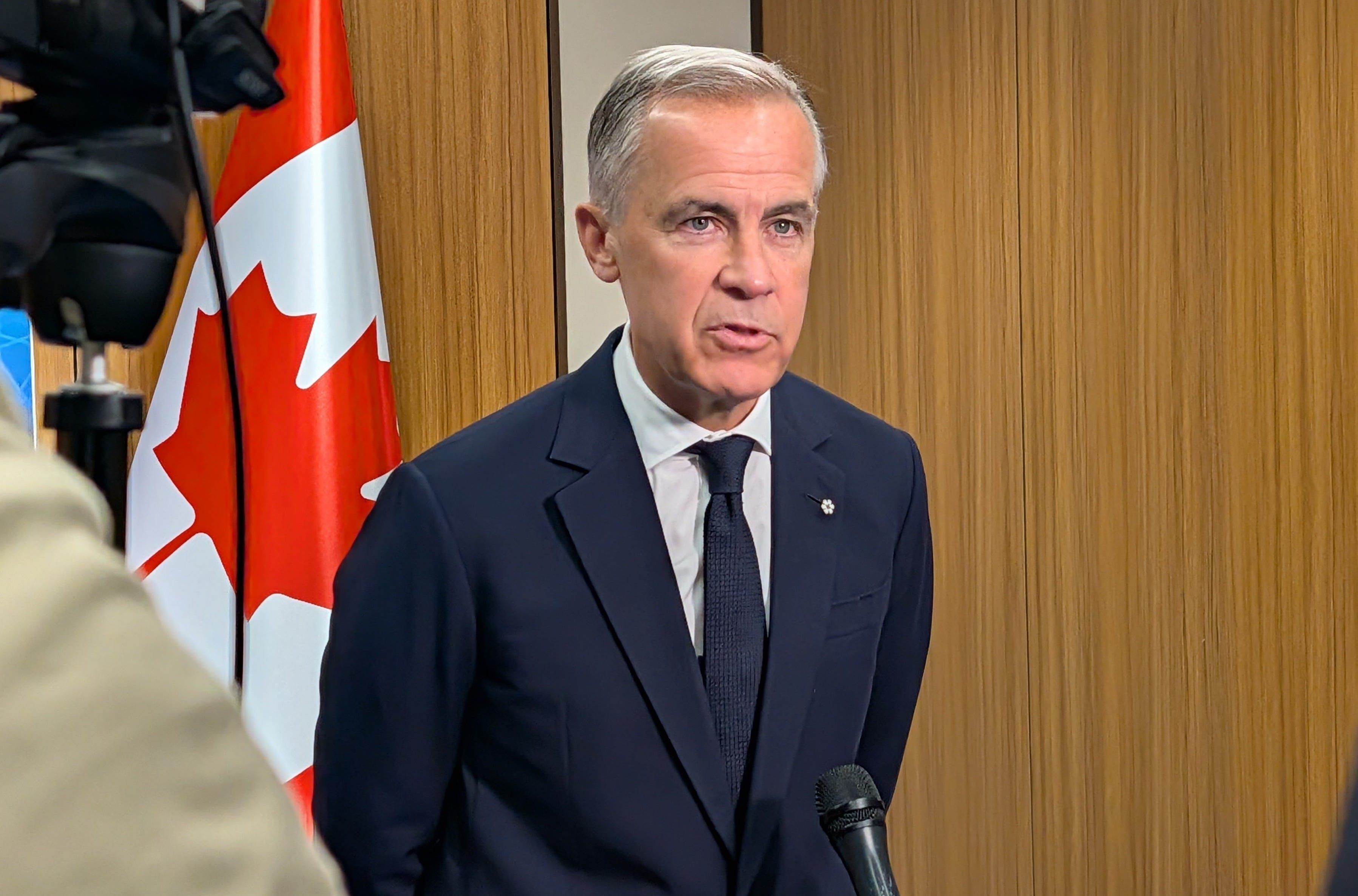
On Wednesday morning, Mark Carney spoke to reporters on his way into the summit’s main plenary session. I asked him: Is there a mismatch between Alliance leaders who want to talk about what NATO can do, and a US President who’s fixated on what NATO won’t do?
“The alliances is a defensive alliance,” Carney replied, restating something that’s true, worth repeating, and consistently uninteresting to Donald Trump. “It’s important… that we put ourselves in a position where we can defend our citizens. That robust defense has to be highly highly credible to deter attacks and prevent the type of suffering we’re seeing in Ukraine.
“Yes, the president of the United States had a desire for more offensive support with respect to the Iran conflict. And it wasn’t a direct ask of Canada. We didn’t have the capabilities, we’re not relevant from a base perspective in that theater. And that’s between him and specific NATO allies.”
Translation: if Trump is angry at Germany, France, Italy or the Brits over Iran, he should take it up with them, rather than blaming the military alliance at which he keeps running into the leaders of Germany, France, Italy and Great Britain. Sure, but perhaps it’s unsurprising that such distinctions sound to Trump like so much nitpicking.
I ran into an acquaintance from NATO’s administration who grumbled that the focus of these meetings is always on Trump’s mood. A Europe-plus-Canada that can handle the sort of big logistics that Rutte announced is “kind of post-Trump,” this person said gamely. Maybe. But if Trump’s mood leads him to write NATO off as an alliance in defence of decadence, as he seems constantly on the verge of doing, NATO might wind up being a lot more post-Trump than it counted on.
Back home, citizens will also have questions about what their governments are buying with their suddenly soaring defence budgets. Not in terms of capability but of purpose. All the questions Carney faces — about whether he’s taking the sign out of the window or Making America Great Again — are amplified in a world of lethal force with nine zeroes at the end of all the numbers.
He told reporters the fall budget will answer some of the fiscal questions. “We will lay out, in the budget, an update with the decisions we’re taking, where the fiscal track is with the defense spending, how we’re spending the one and a half percent on defense-related expenditures, resilience expenditures,” he said. “And that’s the right time to do it.” He argued that Canada is overdue to shoulder its responsibilities. “We’ve got 15% of the world’s coastline. Arctic security is not a ‘flank.’”
I’m a big advocate of much of this security spending, and have been for some time. But as the numbers get bigger, the questions about the point of it all will grow apace.
I think a reduced role by America in NATO is a good thing. Canada and her European allies are capable of taking more responsibility in dealing with whatever problems Russia causes. I would like to see America (who hopefully will have somebody more competent as president after the next election) to continue to be involved, but in a lesser role. China is the most pressing threat right now, and America needs to pivot to the Pacific.
We absolutely need to strengthen our defence. Such a dear price for murmuring “ oh well, Ukraine is over there and us guys will show that Putin what’s what!” It never happened and the collective western world is paying a big price for wishing it would all just go away.