
The Q&A: "There wasn’t an elevator pitch for my stories"
Journalist Susan Orlean on a life of writing about the stories you didn't realize were stories

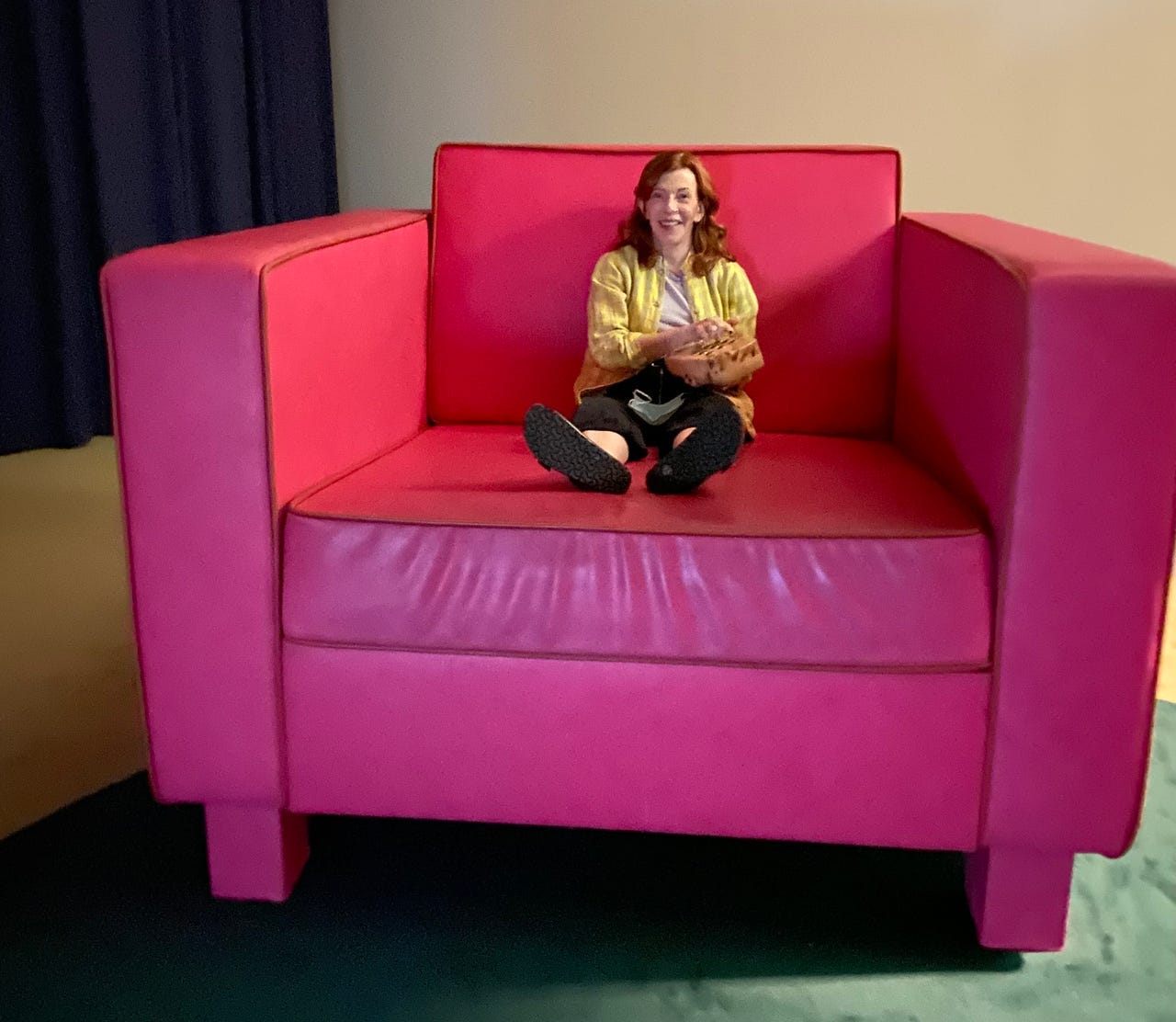
When I heard Susan Orlean had a memoir coming out, I could hardly have been more eager to talk to her. She’s a hero in journalism circles, although people who don’t write for a living sometimes need a bit of reminding.
Susan Orlean is an American journalist. She’s been a staff writer for The New Yorker for decades. She specializes in richly reported stories about things you weren’t expecting to read about. Not the big political stories, but the ones we might not have noticed if Susan Orlean hadn’t written about them. Her last book was about public libraries. Her most famous story was probably the one about a Florida orchid heist, which became the book The Orchid Thief, which became the movie Adaptation. Meryl Streep played Susan in that movie, sort of.
With her latest book, Joyride: A Memoir, Susan’s subject is herself. Maybe the perfect example of one of her specialties, which is the story that’s been hiding in plain sight. The title, which seemed a little offhand to me at first, turns out to be perfect. Anyone who writes for a living, especially anyone who gets to write about whatever they want to write about, is on a joyride.
I realized a couple of times in our conversation that I might be giving the impression that Susan’s an old pal of mine. That’s almost completely false. I met her once several years ago at the Banff Centre, in the Rocky Mountains, where she was teaching the legendary Literary Journalism program, and I was just hanging out. We had one good talk. I told her about a book idea I had, one that could hardly be further from the stuff I usually write about. One that I’ve never been sure would work. Of course, she told me I had to do it. I haven’t yet, but I’ll keep you posted.
Meanwhile, here’s my second conversation with Susan Orlean. Like all my other Q&As, this one was edited for length and clarity. Here it is on video, followed by the transcript.
Paul Wells: Susan Orlean, thanks for joining me.
Susan Orlean: I’m so pleased to be in conversation with you.
PW: You have a new book. And it’s not a book like any other — for any writer — because it’s a book about yourself. And I get the impression you needed to be sold on the notion that people would want to read a book about you. How did that process go?
Orlean: I was very resistant. I am not somebody who loves memoirs in general. It’s not my favorite kind of reading. But also, the entirety of my professional life has been writing about other people and using whatever talent I have for that purpose: to observe other people, to illuminate lives that might otherwise not get noticed. There was a big part of me that thought, “I’m a journalist. Why would my life warrant being examined for 300 pages?”
It wasn’t a story filled with great dramatic traumatic arcs. It wasn’t, “I’m now going to reveal this traumatic story.” It really was, in many ways, a celebration of the privilege I’ve had to do the work that I’ve cared about. But I continued feeling, really, who cares?
Finally, I had to step back and think, you know, I really have had an unusual life. Being the kind of writer that I’ve been, even for a writer, is fairly unusual. For a person who isn’t in this profession, the range of experiences I’ve had, the places I’ve gone, the people I’ve met, it’s a pretty unusual way to have spent the last 40 years. So I kind of twisted my own arm and said, “This is a story that is worth telling.”
And the things that I care about as a writer, I really care deeply about. Sopart of the the way I persuaded myself was feeling like, you know, I really want to explain to people why I write about what I write about and why that matters, since it’s not always so obvious — in the world we live in — to do the kind of work that I do.
PW: It was going to be a how-to book. But then as you unpacked your own story, it became more a book about your life — but still to some extent a book about the craft, and a book that drops a lot of big hints about how to do the craft. How did that journey from a book about what you do to a book about who you are happen?
Orlean: It was gradual. I did originally think, all right, I’ll do a book about writing — although I never thought of that as something that would be interesting to write. I enjoy teaching. I like talking about the craft. So, it was a subject that I was interested in, but I thought the actual writing of a book like that would be kind of dull.
So I thought maybe there’s a way I can make this more narrative. Maybe what I’ll do is take one of my stories and break it apart, literally tear it down to the studs and describe the entire undertaking and the mechanism of doing the story. The thing is that it felt like it needed context. How do you just take a story? Particularly the kinds of stories I do, where I felt like I had to explain how I came up with the idea, why I came up with the idea, where I was in my professional life that gave me the confidence to do a story that was not an obvious story.
The story that I had originally planned to use was a piece called “The American Man at Age 10,” that is a profile of a very regular ordinary 10-year-old suburban kid who lived in New Jersey. It seemed to me that you can’t just say, “Let me tell you how I put together sentence number one, sentence number two,” because the whole idea of doing that story to begin with felt like it needed explanation.
So the further I kept backing up to give context, I kept backing up further and giving even more context. How is it that I came to the point where I was willing to take the chance and say to an editor, I want to write about an ordinary kid?
Finally, it felt like I can do both of these things. I can tell you who I am, how I even got started in this profession at all, and how I got to the point where that story was even a possibility, let alone something that becomes sort of emblematic of my career
Then it made the whole narrative of Joyride feel like it was all of a piece. That telling you the story of, in particular, a few of the stories that really were like tent poles in my career, made sense if you got to know me and understood the arc that I was on as a writer.
It’s such a personal profession. It’s very hard to separate the story of who I am with the story of what I do. They’re very intertwined, perhaps more than a lot of other professions.
PW: This book is an extension of your ongoing work as a mentor and educator for younger journalists. I met you at the Banff Center in Alberta in, probably, 2017-2018 where you were teaching the creative non-fiction course. Are you ever nervous that this is a line of work that maybe we shouldn’t be enticing young people to get into? I ask myself that question every time I get roped into a mentoring situation.
Orlean: Listen, I had this experience even closer to home. My son at one point — my son is 20 now, but he made some glancing reference to maybe he would consider becoming a journalist. And my stomach flipped and I thought, “Oh, no, no, no, no, no, no. This is a really difficult profession. It’s arguably shrinking. It’s a really hard way to make a living.” And I’m telling this to my own son.
Believe me, I take a beat every time I hear someone say, I want to practice the profession as you practiced it. I think it’s a legitimate question to say, can you do this in this day and age? I’m not willing to say no, you cannot. But the building blocks that I used to get to my profession are largely gone. And I don’t have a new, rebooted version of how you get to this place.
I used to feel very comfortable saying to young journalists: “Get a job at an alternative news weekly or go to a small or medium-size city and get a job on the local paper. Write for the Sunday magazine and start building up your clips so that you can then approach these bigger magazines to do the stories you want to. Well, alternative news weeklies are gone. Many small and midsize newspapers are gone. Sunday magazines are gone. And so I find myself thinking, well, how do you do this now?
PW: There’s almost infinitely more ways to get some of your words in front of some eyeballs, but very few of them feel like a career path, right?
Orlean: I think you’re absolutely right. I think you can be read more easily than you could in the past, but how do you make that a career with pay? To be completely blunt about it, how you get paid to do that is not so clear.
PW: I’m curious to see how your book does with a general audience over time. I mean, everyone should read it. But the reason it’s going to become a mainstay of journalistic education is how much of the book deals with technique — the actual stuff you have to do to make a big project happen. There’s a long interlude where you talk about discovering that cue cards could help you write The Orchid Thief and sort of keep track of all the ideas that you wanted to jam into that book. Technique is something that we don’t often discuss in polite company as journalists, but it’s make or break for a successful story and a successful career.
Orlean: I didn’t go to journalism school, so I truly can’t speak to what you’re taught in journalism school, but someone said to me once, “Oh, how wonderful it must be to have an office at The New Yorker and you all sit around talking about how you do your stories.” And I said, “No, we don’t.” I mean, we sit around talking about who won the baseball game last night or gossiping. There is much less discussion of the nuts and bolts than you would think.
I kind of fell onto the technique of using index cards because John McPhee wrote about using index cards and because he’s someone who I admire so much and because his explanation of how he used them really made sense to me. I thought, well, nobody else is giving me a template for how to manage a massive amount of facts and interviews and information. It’s very kind of dry stuff. How do you make sure you can find the piece of information you need when you need it?
If you’ve been interviewing and researching for three years and you’ve accumulated massive amounts of files and note cards and pages, how do you find the stuff that you need and organize it to give your book structure? It’s kind of fascinating. It’s interesting, because on one hand journalists find it very interesting, but I’ve also found that non-journalists find it fascinating too. I think partly because they’re reading the finished product and they really have no idea how it works. Particularly because my books are deeply researched and I’ve got lots of facts, lots of information, and they are genuinely curious to know how you put that together. How do you organize all of those facts? It’s very interesting to see how the sausage gets made even if you don’t plan to become a sausage maker.
PW: The point on the horizon that you were steering towards — almost from childhood — was writing for The New Yorker. And yet almost all of your discussion of The New Yorker in the book suggests that it sure wasn’t the champagne room at the Viper Lounge. You were an odd fit for it, and it was an odd fit for you. And then the management changed, early on. And one of the surprises in the book was that you weren’t sure what to do about the fact that Tina Brown was editing the magazine. Tell me about your early days at The New Yorker.
Orlean: I came in during the regime of Robert Gottlieb and he had taken over the magazine when William Shawn was sort of pushed out. And as much as it was a change, they were cut from the same cloth. They were both very literary, very literate, intellectual men. Bob Gottlieb didn’t change the magazine very much.
So I entered the magazine under Gottlieb’s tutelage and things were pretty status quo. Five years into his stay at the magazine, Gottlieb got pushed out and in came Tina Brown. Tina was a very different breed of cat. She was running Vanity Fair at the time. She had brought to Vanity Fair this very kind of snappy, of-the-moment combination of deeply reported stories, but also stories about new money, about celebrity, about sex scandals - things that were a lot more fizzy and bright and big-headline kinds of stories.
I had no idea whether Tina Brown was going to take a shine to the kind of work I was doing. Quirky, small-headline kinds of stories. There wasn’t an elevator pitch for my stories. My hope was that I would make [my stories] so irresistible that you couldn’t not read them. I had done a story before Tina came about a grocery store.
I spent a month at a grocery store in New York because I got really interested in the sort of day-to-day goings on at a grocery store. It just became really fascinating to me, particularly because it’s such such a common denominator. Everybody goes to the grocery store. It doesn’t matter if you’re old, young, rich, poor, you know, it’s one of those cohesive fixtures in a community. And that’s the kind of story that Tina explicitly did not like. There was no protagonist whose life was dramatic. There was no drama in the story. It was all about being observational. It was the anti-celebrity story of all time. Tina very explicitly said, “This is the kind of story I’m not going to be doing.” So when she came to the magazine, I thought: “Well, I’m cooked.” She’s absolutely not going to be interested in my work. I was heartbroken. I loved being there and I really felt like it was the right home for me.
To my pleasure — and I think it was partly expedient on her part — she just needed to fill the magazine while she set it up for her new regime. And she said to me: “Go ahead, get started.” I’m sure she thought, “Let’s see how this goes.”
The first story she assigned to me was a profile of Mark Wahlberg, who at the time was an underwear model and a rapper who went by the name Marky Mark. And I thought, “Oh my god, this is my nightmare come true. I’m gonna be profiling Marky Mark.” But what I did was write what turned out to be an extremely funny little piece about him. Because look, I think you can write about Marky Mark just as well as you can write about a grocery store. Being a writer, you have certain skills that should be able to translate into a lot of different stories.
PW: That’s the one where you wrote it as a Talk of the Town, so that you could write as much of Marky Mark as you could stand to write, instead of writing a feature.
Orlean: Exactly. Tina wanted me to do a feature, and my heart sank because I thought, “Oh, God, I just can’t imagine a 4,000-word piece on Marky Mark.” She wanted it right away and I proposed to her, let me do it as a Talk piece because I could do it quickly. In the space of a Talk piece — which is between 600 and 1,000 words — I felt like there is no subject that you can’t do well.
He was very funny. He was at the height of this very unusual kind of fame, namely that there were pictures of him in his underwear posted throughout the world, including a huge one in Times Square. It was a funny story and it satisfied Tina. So it worked on every level. But the most important thing is that she began to trust me. She began to feel like maybe we see the world a little differently, but maybe this writer understands what she is good at and maybe she can take on these riskier stories and pull them off.
PW: And in the end, you end up writing the Orchid Thief piece for her. So her tolerance for your quirkiness seems to have increased by leaps and bounds as you went along.
Orlean: One hundred per cent. I think she began to trust me and feel like my impulses were pretty well calibrated to my particular skill set. I think that she felt that that was the kind of story you couldn’t assign to anyone and everyone. I took it as a huge compliment because she was saying, “I trust you to do this tricky story that could fall flat on its face.” But it put a lot of pressure on me.
But since those were the kinds of stories I was so interested in, it really was about me saying to the reader, “Look, I know it doesn’t seem like a big deal to steal orchids out of a swamp, but it’s so interesting. Come with me for a minute. Let me show you why this is genuinely interesting, and even more interesting because you didn’t think it would be interesting.”
PW: One of the recurring themes of the book is one’s relationship with editors and agents and the people around you who either help or screw up your work. We’re grown-ups and our main business is with the reader and with the subject. But if we’re not understood and trusted by editors and publishers it can really cramp our style.
Orlean: I’ve had a lot of great editors and so I always hesitate when people say, “Oh, you know, my editors always ruin my work.” I have trouble believing that. However, editors operate on a lot of different levels like telling you when a story is due even if you’re not ready to turn it in, or pointing you in one direction when you see it going in the other direction.
They are a fact of life in the world of publishing that can be either very empowering and wonderful or very challenging.
PW: I remember the first time I got a really hard edit on a story. It’s 30 years ago now and it was a story I cared a lot about. It was for a magazine and I was despondent. I read it and thought, “This is not what I wrote.” And I took the weekend off and I pondered other career paths. And then finally this rebellious little thought crept in my head: I think he’s made it better.
Orlean: That’s a really important part of maturing as a writer. I told at length an anecdote in the book about the first time I turned in a piece to The New Yorker and I was very proud of the ending. I turned in the story and my editor said, “The story really works.” And then he handed me the galleys and he had taken a red pen and crossed out the conclusion and I almost died. That was my grace note where I was concluding what the story was all about! And he said: “You don’t need it. You already ended the story. You don’t need to put an end on the end.” So that was an instance where I really cringed at the editing and was having a fit thinking, “Oh my god, this is horrible.” And with a little bit of wisdom and a little perspective, I thought, “Oh, I get it. I see.” And it was extremely formative for me.
PW: I think you phrased it as: “When the story ends, the reader’s still leaning forward.”
Orlean: Those are things that I learned by being edited. To this day, I feel like one of the best things I’ve learned over these many decades of being a writer is not to overreact, not instantly get defensive and think you’re ruining my story, but instead to stop and think. Let me look at this and try to look at it as a reader and not as a writer. And I would say more often than not, I come away thinking that was a good change.
PW: Susan, you’ve been so generous with your time. Maybe one last question for people who don’t read your Substack. Can you tell everyone how the Trump tariffs nearly derailed your book tour?
Orlean: Oh my God, this was an incredible story and it was very funny because it got a lot of traction on Substack. I write on Substack, it’s called “Wordy Bird” and I write about whatever is on my mind, but I’ve written a fair amount about fashion because I love fashion. I was looking for an outfit for my book party and I wanted something really special. There’s a retailer based in Montreal called SSENSE that I shop with frequently. They have great clothes. I found an outfit that I really liked on SSENSE and ordered it and I ordered a couple of different tops and a pair of shoes and the full Monty. I was waiting and waiting and it took an unusually long time to arrive. Finally, I got a note from the post office saying, “You have to come pick up your package at the post office.” And I was very puzzled and thought, “All right, I’ll go.”
I arrived at the post office and the clerk looks up my card and says, “Yeah, I’ve got a package for you.” and she said, “You owe, let’s see, $2,101 in customs fees.” I started laughing and I said, “Oh, very funny. You know, what’s the story?” And she said, “Uh, that’s the story. You owe $2,101 in customs fees.” I almost died!
What had happened is the Trump tariffs had just gone into effect. And the reason this package took a long time was that it was sitting in customs as they were assessing how much I owed. And I said to the postmistress, “I’m not even going to touch the box. Just send it back.” She said, “I’ve been doing a lot of that today!”
I’m happy to say I found something that I already owned that worked very nicely for my book party. But it was a very sobering moment where this political era had a very personal impact on me.
PW: Well, I’m glad you’re able to go shopping in your closet and that it worked out well. But this confirms what we all feel up here, which is that it’s strange days in Canada-US relations.
Orlean: We find it as weird as you do. And since we’re on the receiving end of being charged for those tariffs, we really feel it. And people are just dumbstruck.
PW: Well, it’s very good to be able to wave at you across the border, Susan Orlean, thanks.
Orlean: No tariff involved!
I'm ordering the book. Thank you.
Loved this…liked your ending! Also love Susan Orlean’s writing