


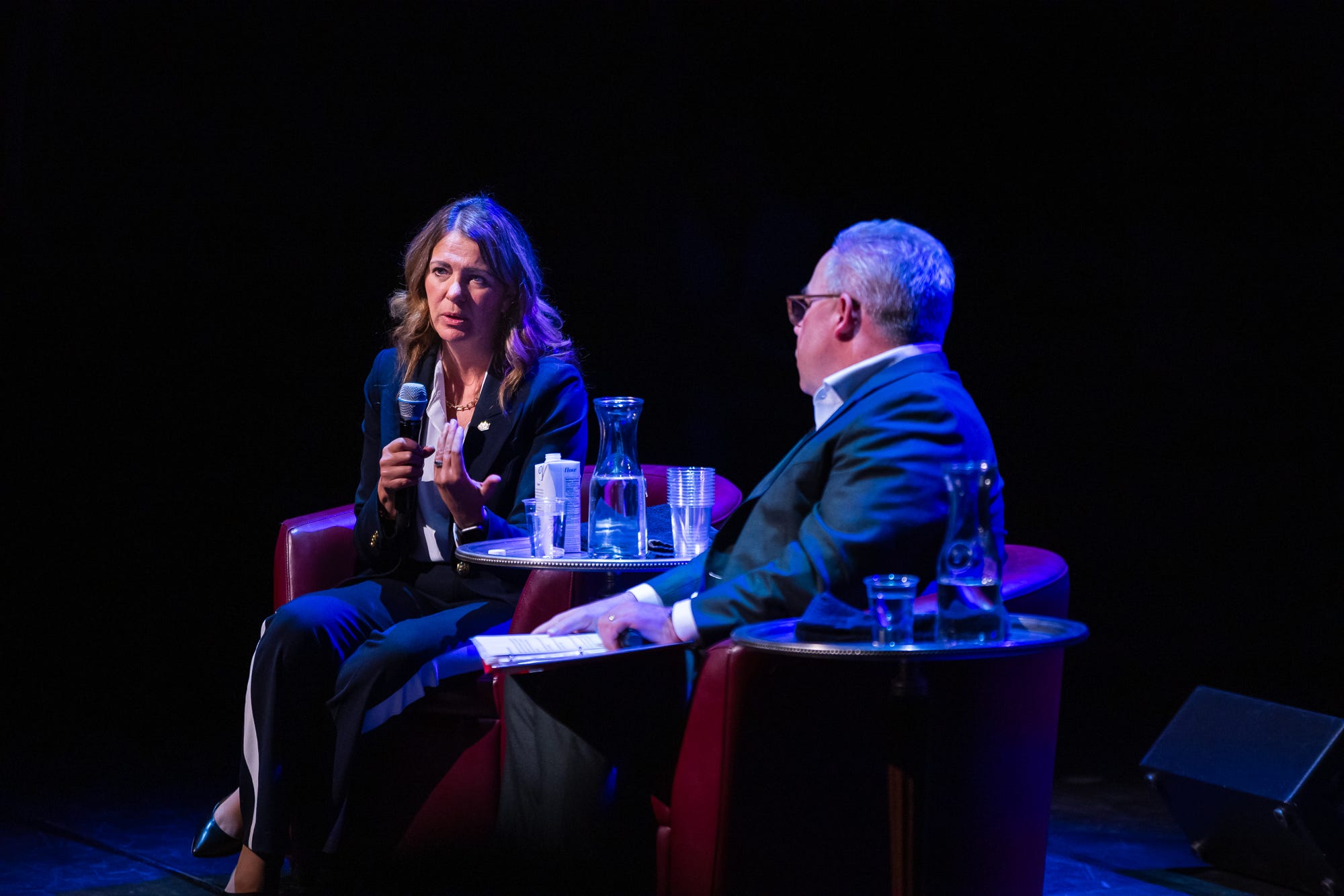
1. Full house
It’s such a great honour to be welcomed by 400 people in Calgary on a school night for a celebration of creation and community — and a discussion of serious things.
Uploading the audio just now, I see my Calgary Road Show ran well over an hour and a half. Fair: we had a lot to discuss. Our sold-out show at the beautiful Martha Cohen Theatre, home to Alberta Theatre Projects for more than 40 years, took place on Monday night: three weeks to the day before Albertans will vote in ten referendums. Including the big one, the referendum on whether to have a referendum on secession. Of course we had to talk about that.
Danielle Smith was there, for my third interview with her as premier. I pushed her on whether this whole procedure makes any sense, and on whether some prominent separatists’ push for “leverage” in negotiations with Ottawa empties any Leave vote of any meaning. She defended herself gamely. Of course different listeners will judge all this in different ways. At one point, I realized that part of the audience was clapping for her and part for me. I discouraged the practice.
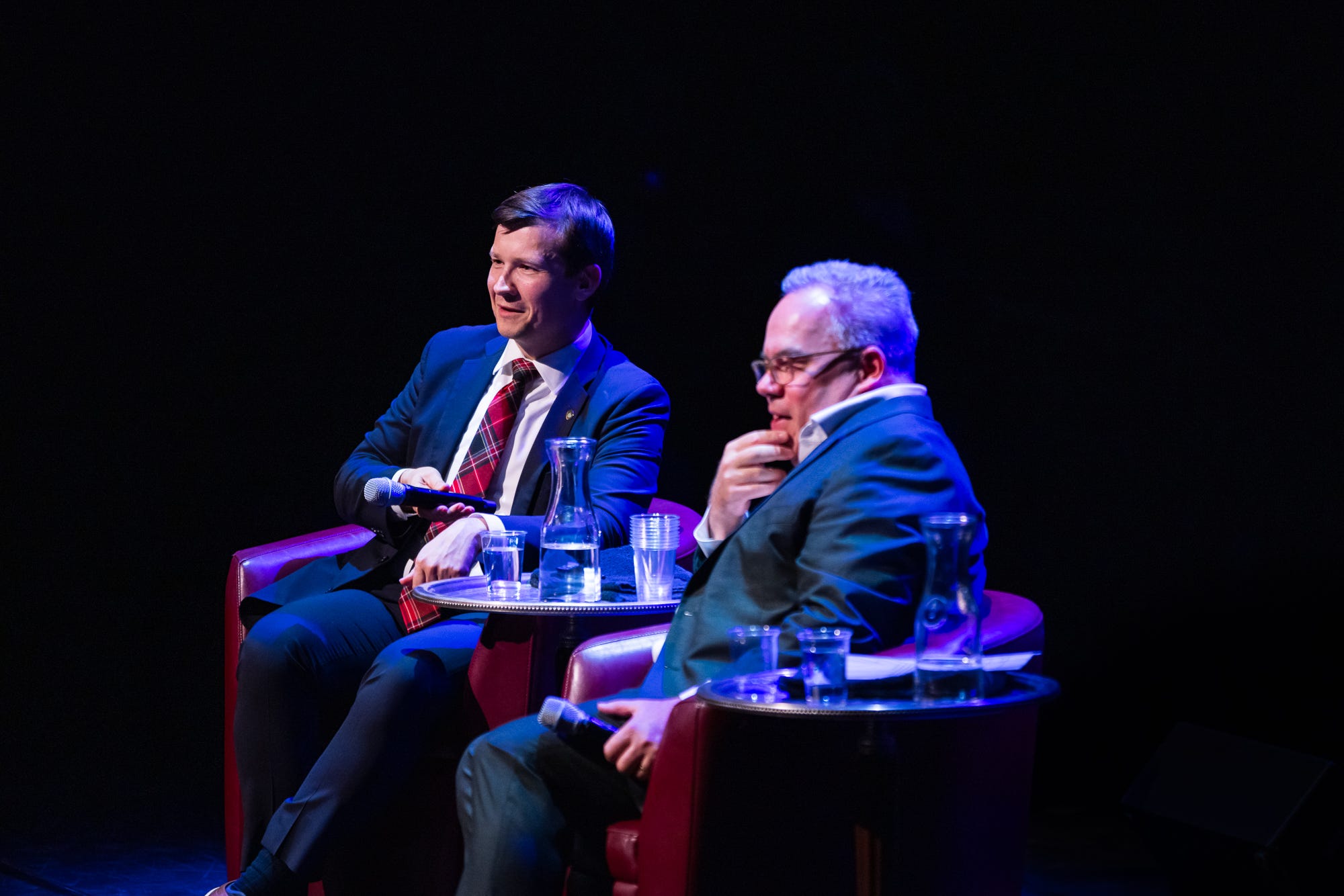
Jeromy Farkas was there, in the audience and then onstage. Calgary’s mayor won last year’s election by a hair and does not intend to underperform in office. We discussed the challenges of governing a big city, big inherited infrastructure problems, relations with the provincial government, and the referendums. Some elected officials are refusing to say how they’d vote on separation. Farkas and Calgary Council had no such difficulty.
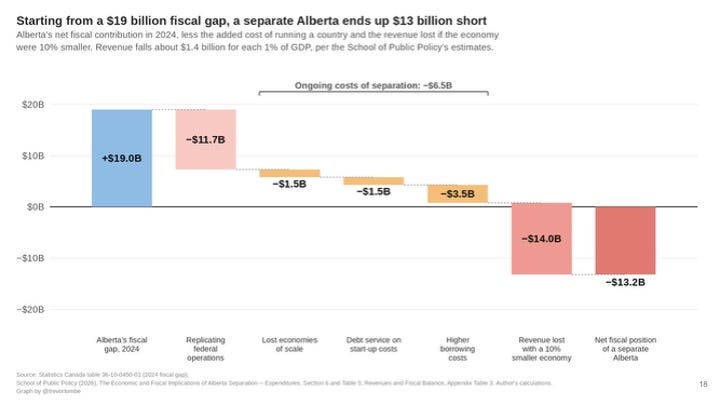
University of Calgary economist Trevor Tombe was there. People were really excited to have Trevor Tombe there. With slides, at my request. Which you’ll just have to imagine, for the most part, but this one was perhaps the most important. It shows how a province that pays $19 billion more to the rest of Confederation than it gets back in a year could lose that advantage, and more, by trying to leave:
Kate Thompson was there from the municipal agency responsible for a startling, long-term series of government and private investments in arts infrastructure in downtown Calgary. Here’s the Calgary Municipal Land Corporation’s website explaining these changes; here’s one of Thompson’s slides, showing a new building for Werklund Centre’s performing-arts complex, going up across the street from where we had our show. Multiplied across several comparable projects, this is the sort of thing that can change the way a city thinks about itself:

We had two music acts. The Dust Collectors sound like young Alberta, country with just a hint of punk attitude. Jesse Morrison is a viola player in the Calgary Philharmonic Orchestra. I sent him onstage with very little explanation, and people loved his performance. The names of both performers in this paragraph link to their Bandcamp pages, where you can buy their albums if you like what you hear in the show. It’s a great way to support the work of working musicians.


2. Thank you, Alberta
At each of these shows, I deliver some remarks, a kind of monologue I’ve started to think of as Story Time. What I said in Calgary was, inevitably, partly about the decisions at hand. I don’t hesitate to take politicians to task for their remarks on momentous issues. It’s only fair to share mine. Here are my remarks from Monday’s show, with some of the slides I showed while I was speaking.
As far as I can remember, the first time I visited Calgary was in 1981. I was 14.
My brother David lived near here, as he does now, and he took me straight to Peter’s Drive-In in Crescent Heights. “The Drive-in You Can’t Drive By,” it said on the sign. You still can’t. As most of you know, it’s still there today.
Back then, Peter’s was having a moment. They’d just moved across 16th Ave. to a bigger location. I ordered a burger and a small order of French fries. I guess at Peter’s the definition of “small” is a relative thing. I think I finished eating those fries a few years later.
The first time I came here as a journalist was in 1997. Quebec had voted on whether to leave Canada, and it was close. The idea still had a lot of momentum. So Ralph Klein and the premiers of the other provinces were trying to think of nice things to say about Quebec.
That led to something called the Calgary Declaration. Off we went to Calgary so they could tell us what it said.
Before I left Ottawa, a friend of mine from a Quebec City newspaper called me to say a bunch of the Quebec reporters would be going out for dinner during the premiers’ meeting, and would I like to join them.
It was nice to be invited. But I was nervous. “Are we going to speak French?” I said. “Is that okay in Calgary?” He just laughed. Of course it was okay, and of course dinner was better than okay. And that was the first of many good times I had as a grown-up in Calgary.
Journalists have been visiting Alberta forever, because journalists love a story and there are always a bunch of them here. In 1955, Maclean’s magazine published a special issue to mark 50 years since Saskatchewan and Alberta joined Confederation.
The editor of that magazine in those days was Ralph Allen. From Oxbow, Saskatchewan. The local museum there is still named after him. Here’s some of what he wrote in that special issue:
“The belief that the west goes on repeating itself, mile after mile/ and year after year/ and generation after generation, has never stood up under close scrutiny.
“Neither has the belief that it is almost wholly populated by the same kind of people doing the same kind of thing for the same kind of reason.
“There is scarcely a man or woman living anywhere in Europe or North America who could not, somewhere in Saskatchewan or Alberta, find a sizable community that speaks his language sings his songs and worships his gods. But he would still be, first of all, among Canadians.
“In the eight thousand miles I have traveled this year in Saskatchewan and Alberta, nearly everything I have seen has confirmed my boyhood belief — tested by countless excursions after gophers, learning, money, girls and salvation — that anyone who thinks he knows what to expect next from that part of the world is an optimist. Not an optimist about the west itself — for there is a great deal of ground for optimism there — but an optimist about his own powers of divination.”
Twenty-one years later, in 1976, Christina McCall wrote about Alberta for Saturday Night magazine. Now, Christina was from Toronto. And it showed. But she was a frequent visitor to Alberta at the height of the 70s oil boom. She wrote:
“Every time I go there, as soon as the interviews begin — over lunch in the Owl’s Nest at the Calgary Inn, say, with the interviewee sipping his first Bloody Caesar and people at nearby tables talking at the top of their enthusiasm range about wellheads, bull semen, rapeseed, drilling rigs, and riding rings — I get a feeling, both unsettling and exhilarating, that somehow I’ve strayed into a foreign land.”
And she wrote about a new generation of blue-eyed Sheikhs, about Peter Lougheed, Don Getty, Merv Leitch, Hugh Horner. “These men have strengthened resolutely their indépendentiste position, making moves that have caused complaints that they’re covert separatists.”
As for me, my own connection to Alberta began before I started tucking into that order of fries at Peter’s Drive In. In important ways, that connection began before I did.
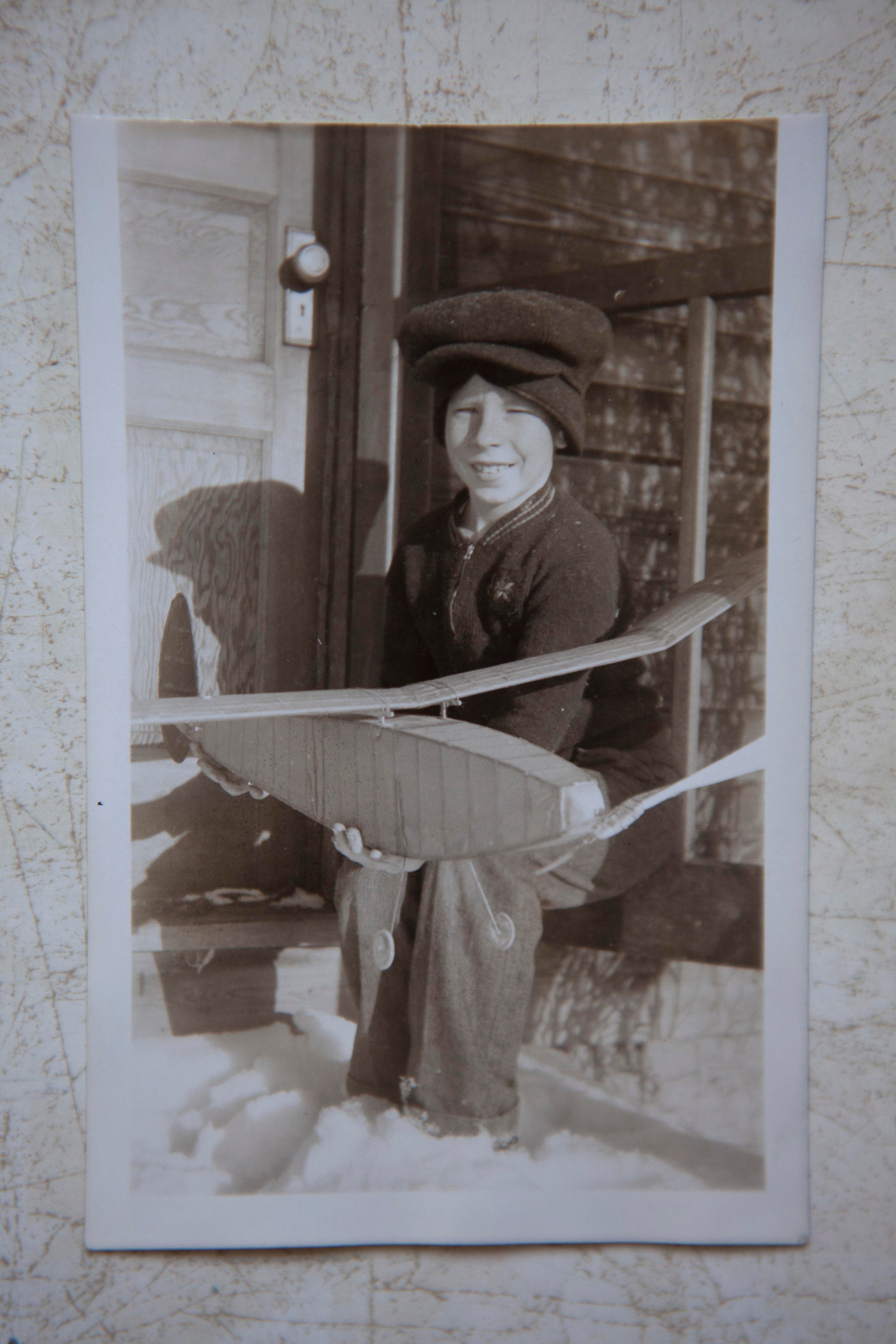
My father, Allen Wells, was born in January 1931, on a homestead just south of Fort Macleod. “1931 was not a good year in which to be born in Alberta,” he wrote in his memoir. “The price of marketed wheat had fallen to below the price of seed. The constant dry winds carried topsoil, newly planted seed and hope, all away, together.”
Crop failure led to bank debt. A bad tenant led to bank default and foreclosure. The family moved to West Bend, Sask., where they lived, “probably eight people in two rooms,” for two or three years.
Back home in Alberta, my dad went to school, in Vermilion and then in Islay, usually with his older sister Jean, sometimes on horseback. He reports that fairly often he would fall off the horse and Aunt Jean would put him back on it.
By the time he was 13 he was in Grade 10, which is two years ahead of schedule. In 1947 he became the youngest student to study agriculture at the University of Alberta. He graduated in 1951, at 20 years old.
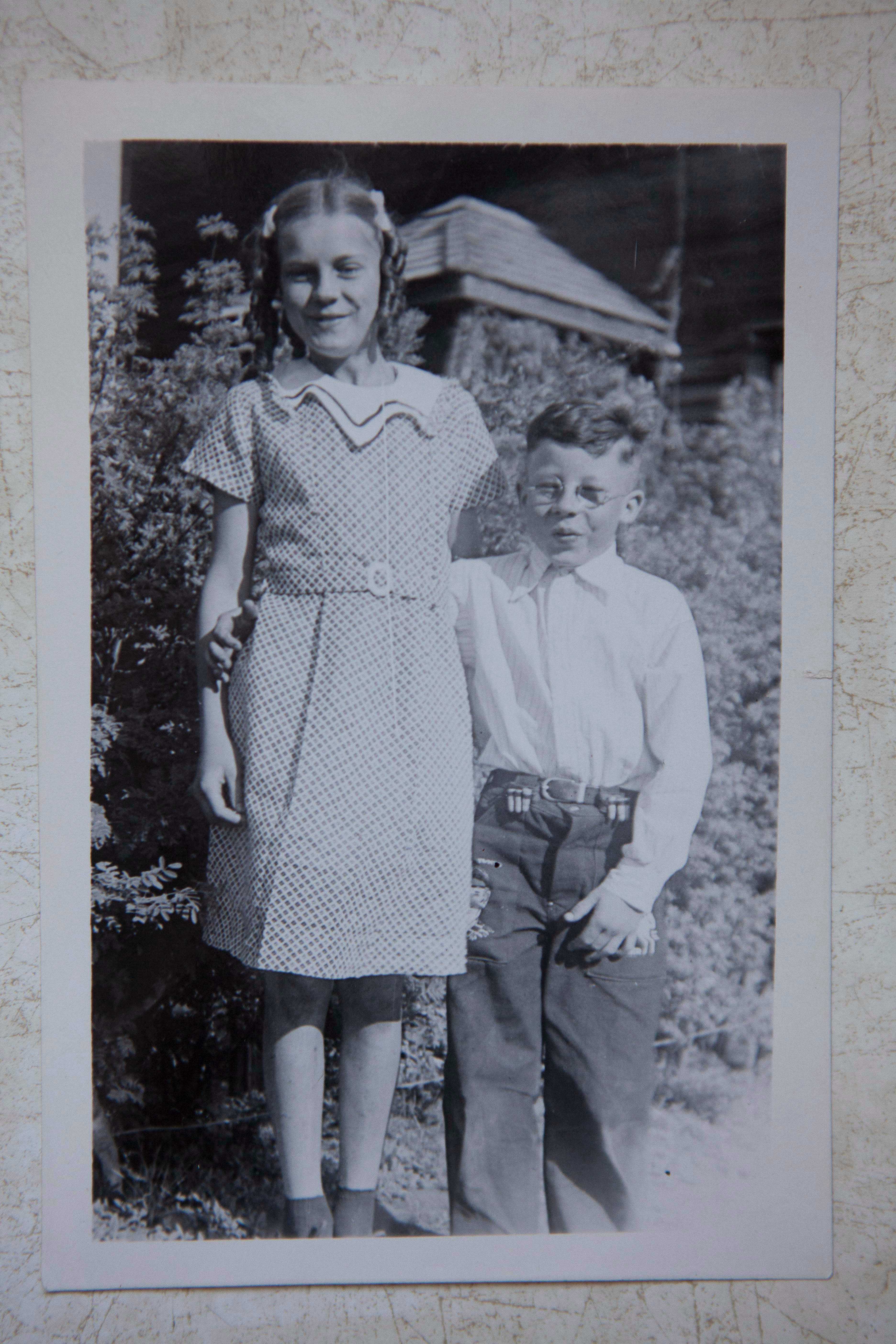
Soon after that he left Alberta. He never went back for long, but his mom lived out her days here, and his sisters Margaret and Jean. For most of my life there’ve been more Wellses in Alberta than in Ontario or anywhere else. There were also a bunch of Samsons, which I didn’t know anything about until I married one.
None of this gives me any special insight into the Alberta soul. Everybody has parents. But it might help explain why I’m always surprised when people start talking as though there’s some kind of line between here and where I usually live.
Or as though there should be.
I’m not blind. I know we had a prime minister who didn’t push back hard enough against the polarized politics of our time, and who spent the last years of his career trying to turn that polarization to his advantage. I know too many people in my part of the country say Alberta as though it’s a bad word. Still today, too many do.
And I know, because I’ve spent my adult life watching separatist movements, that people often don’t vote to leave because they want to reject something. They vote that way because they feel rejected.
The thing that’s not as clear to me is what anyone hopes to gain by turning the dotted line of a provincial boundary into the unbroken line of an international border. Who, precisely, are they hoping to keep out? And who in?
In the 2025 federal election there were twice as many Conservative voters in Ontario as there were in Alberta. There were twice as many NDP voters in Alberta as in Manitoba.
I don’t know where you draw a line that will leave all of one kind of people on one side — and all of another kind on the other. COVID vaccinations? In 2023 the rate in Alberta was 94% as high as in Ontario. Immigrant share of the population? Higher here than anywhere except Ontario and BC. Opinions of Donald Trump? Increasingly, about the same all over.
I follow enough of the politics here that I know, as Ralph Allen did 71 years ago, that the belief that this place is populated by the same kind of people doing the same kind of thing for the same kind of reason, still doesn’t hold up to scrutiny.
I get the impression that for a lot of people here, the main question you’ll be asked on October 19 is getting easier to answer. But that doesn’t mean people are glad to be asked.
This, too, is something I’ve seen before, in other places. Simply being asked to choose your group is hard on people. It can make you focus on the ways you’re different. It can make you worry you’re disloyal to the people from home. Or that you’re being played by people from somewhere else.
This summer I was having lunch with two Albertans I love, and they said they’re tired of Alberta being treated like the black sheep of the Canadian family. One said she knew somebody at university who was afraid to set foot in Alberta. The other said she knows somebody at work today who feels the same way.
And I know that’s true. Canada’s always had people in it who are looking for a reason to hate, or mistrust, or just to feel superior. But those people are outvoted by all the people across Canada who beat a path to Alberta every chance they get.
Most years, Alberta wins big — and most other provinces lose — from interprovincial migration. People come from outside Alberta to study in its universities at a higher rate than go to Ontario or Quebec universities.
More people come here for Stampede from the rest of Canada than from the rest of the world. Increasingly, just as a business proposition, if you’re not here for Stampede, you don’t know what’s going on. I rarely spend time in Alberta without hearing people speaking Quebec-accented French. Some seasons in Banff I’d have sworn I was at Mont Tremblant, except somehow the trails got better.
Some people will say, Well, sure, of course people come here when they want to work, or make money, or have fun, or start a new life, or fall in love. To which I would say, yes, those are indeed the sort of things people do. In particular, they’re what people do in a country.
But just having this debate can make people feel lonely. I’ve felt it too.
My wife and I have a family friend who we sometimes have lunch with in Bragg Creek. She said something about all of this that stuck with me. “You know what would be nice? If somebody just said thank you. Thank you for all the energy and the minerals and the beef and the hard work. Just thank you.”
Now, I didn’t come here with any mandate from anybody, unless it’s from you. But this is something I think I can do.
Thank you, Alberta. Thank you for the oil and gas — legal, useful and valuable as they are. Thank you for driving a century’s worth of progress with those resources, and for the ingenuity and hard work that generations of Albertans put into getting it out of the ground.
Thanks for generations of innovation in our party politics. For sending us Preston Manning. For taking Stephen Harper when he moved here as a young man from Etobicoke, and sending him back east with reinforcements. Thanks for Ken Whyte, kd lang, Mark Messier, Brad Fraser, for Marshall McLuhan and Bret “Hitman” Hart. For six Stanley Cups and for showing the world in 1988 that actually, Canada could run an Olympics well.
Thank you, Alberta, for my wife.
And thanks for my Dad.
3. Finally
Thanks too, as always, to my presenting sponsors for this entire season of podcasts and live events. Cameco is one of the largest global providers of the uranium fuel needed to power a safe, secure energy future. The Transition Accelerator drives projects, partnerships, and strategies to ensure Canada is competitive in a carbon-neutral world.

I was also happy to have the Canadian Bankers Association on board as my Gold Sponsor for the Calgary Show. They’ve been a sponsor for many of my events going back to the old Maclean’s Live interviews in Ottawa.

We sure had a great time at Werklund Centre and the Martha Cohen Theatre. My next big live event will be in Ottawa in December.


